Introduction
Why negotiators reach for these tools, what they are good at, and how to read this book.
Climate negotiations run on documents. There are thousands of them, written in a special vocabulary that changes from one session to the next. The exact wording of a text can decide the outcome. AI language models can help you read, write, and prepare faster.
1.1Why should we care?
Youth negotiators at the UN climate talks (the UNFCCC) speak for the generation that will live with today's decisions. Many of them face the same problems. There is too much to read. The policy language is hard to follow. And there is little time to get a point across.
Language models can help with each of these. A language model is a computer program trained on a very large amount of written text. It can read, summarise, and write text on request. For negotiators it is useful in four ways.
Understanding information. Turn long reports and data into short summaries, so you can keep up with new findings.
Drafting. Help you phrase a point in the accepted language of the negotiations, clearly enough that people notice it.
Working across languages. Translate texts and explain their context, so more people can take part on equal terms.
Practice. Play the other side in a mock negotiation, so you can rehearse before the real one.
The tool is only part of it. Negotiators who learn to use it well get more time for the work that needs a person.
1.2How to use this guide
The first half explains what these systems are, what negotiators need, and how to ask a model for something useful. The second half covers agents. An agent is a model that can read a whole set of documents and carry out a task in several steps. The last chapters cover who controls your data, how to run a model yourself, and what AI costs the environment. Every chapter has prompts you can copy. You do not need a technical background.11The first edition was written in 2024 for the Climate Youth Negotiator Programme. The interviews in chapter 3 and the appendix are from that work.
What are large language models?
From the perceptron to the assistant in your browser. What these systems are and how they got here.
2.1How we got here
In 1957 the psychologist Frank Rosenblatt started work on the perceptron at the Cornell Aeronautical Laboratory. The US Navy showed a working perceptron machine the next year. A perceptron is a very simple maths model of a brain cell. It takes several inputs, gives each one a weight, and produces one output. It did not copy a real brain, but today's AI systems partly grew out of it.
Then progress stalled for decades. There was not enough data, computers were too slow, and the training methods were weak. Things moved again when all three improved at the same time. In 2012 Alex Krizhevsky, Ilya Sutskever, and Geoffrey Hinton trained a system called AlexNet on 1.2 million labelled images, using graphics chips built for video games. It got the right answer in its top five guesses for all but 17 per cent of test images, far better than anything before it.11The result came from the design, the training tricks, and the dataset as much as from the hardware.
In 2017 Google researchers introduced the Transformer. A Transformer looks at all the words in a passage at once and works out which ones matter to each other. This lets it connect ideas that are far apart in a text. Transformers are also fast to train on many chips at once. Almost every system in this guide is built on one.
OpenAI then trained Transformers on a simple task: predict the next word. Its early models, GPT and GPT-2, showed that this one task taught a model many skills at once. You no longer needed a separate system for each job. Researchers also found scaling laws. Models got better in a predictable way as they were given more computing power, more data, and more size, as long as those grew together.
On 30 November 2022 OpenAI released ChatGPT as a free research preview. For the first time anyone could chat with one of these models.
Two more changes followed. In September 2024 OpenAI announced o1, and in January 2025 DeepSeek released R1. Both spend extra effort before they answer. They write out longer working notes first, which helps with problems that take several steps. Models were also connected to tools and allowed to act in loops. Chapter 6 covers that.
2.2The recipe
A language model is a type of AI that reads and writes human language. It learns from a huge amount of text: books, articles, websites, and more. From that text it learns patterns, and it uses those patterns to write new text.
ChatGPT, Meta's Llama, and similar models are built in two stages. First comes pretraining. Then comes post-training, which now has two parts. The second part is why recent models can work through long problems.
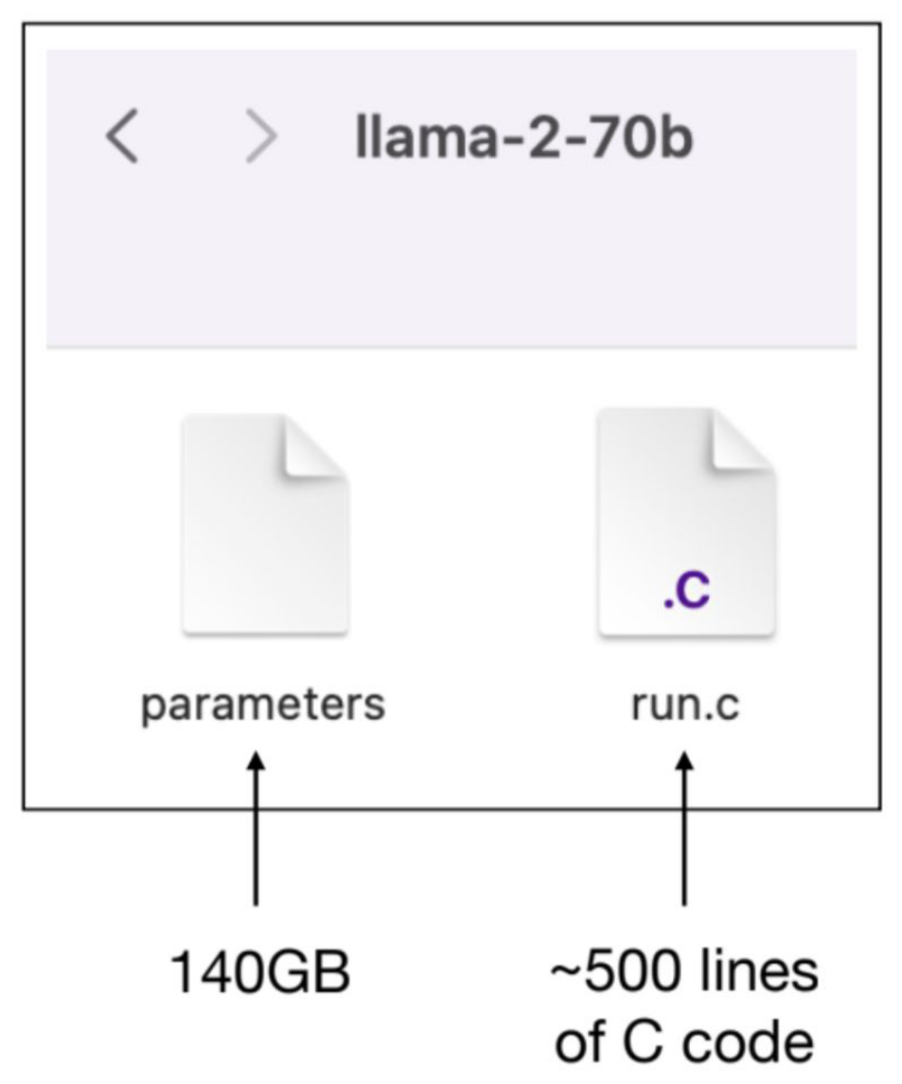
Pretraining. The model reads a vast amount of text from the internet and practises predicting the next word. It does not keep a list of what it read. Along the way it picks up grammar, facts about the world, and some ability to reason. It learns a surprising amount this way, from small everyday facts to hard ideas.
Supervised fine-tuning. The first part of post-training. People write and rate example answers, following written guidelines. The model trains on these examples and learns to apply the same standard to new requests. This step teaches it to follow an instruction instead of just continuing your sentence.
Reinforcement learning. The second, newer part. The model is not shown a correct answer to copy. It gets a reward when it reaches a good result. Over time it learns which ways of working through a problem succeed. This is what lets a model hold a long chain of steps together before it replies.
2.3Limitations
Researchers still do not fully understand how these models work inside. The common view is that pretraining gives the model its knowledge, and post-training shapes how it uses that knowledge.
One thing is clear. A language model picks the next word based on patterns in its training text. That works well for a lot of tasks, but it has two big problems. The model repeats the biases in the text it learned from. And it states false things with full confidence. This is called hallucination. A sentence that sounds right has not been checked.
2.4Where the bias comes from
These models learn from the internet, and the internet does not cover the world evenly. For a climate negotiator this matters a great deal.
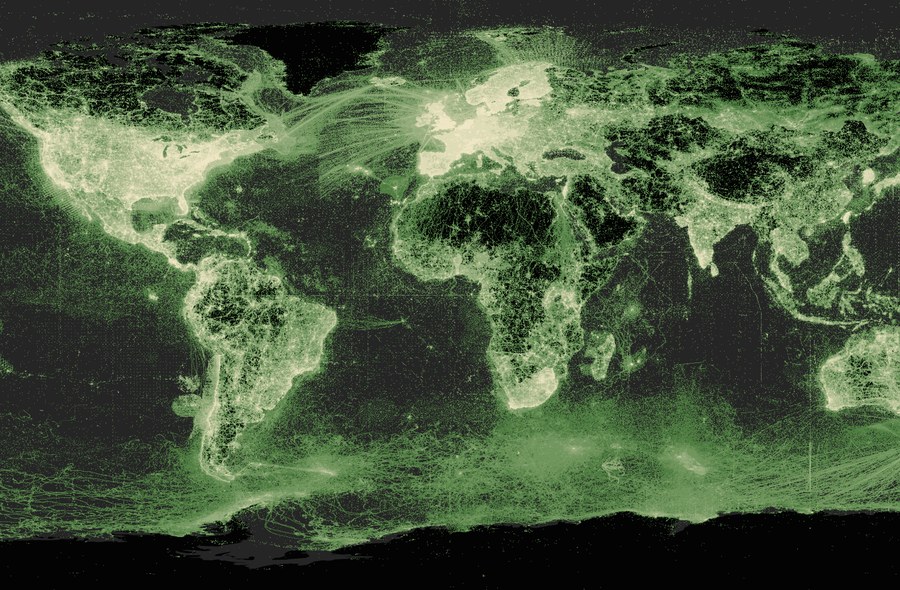
Take nature records. The Global Biodiversity Information Facility (GBIF) is the largest open database of species sightings in the world. About 83 per cent of its records come from North America and Europe. The other 17 per cent covers the rest of the world, including the places with the most species.
Written text has the same imbalance. Far more is online in English, French, and Spanish than in Quechua, Twi, or Tok Pisin. So a model has seen much more of the first group. It will translate, summarise, and draft well in a common language. In a less common one it will make more mistakes, and it will make them just as confidently.
This is also a major cause of hallucination. Ask about a well-documented place and the model draws on a lot of material. Ask about a poorly documented place and it has much less to go on, so it fills the gaps with guesses. The answer does not sound any less sure. It is simply more likely to be wrong.
There is no one to blame for this in a simple way. Collecting and publishing data costs money and needs systems that many countries lack. Some communities choose not to share knowledge about their land and species, and that is their right. But the result is the same. These tools work best for places that already have lots of data, and worst for places with the most at stake.
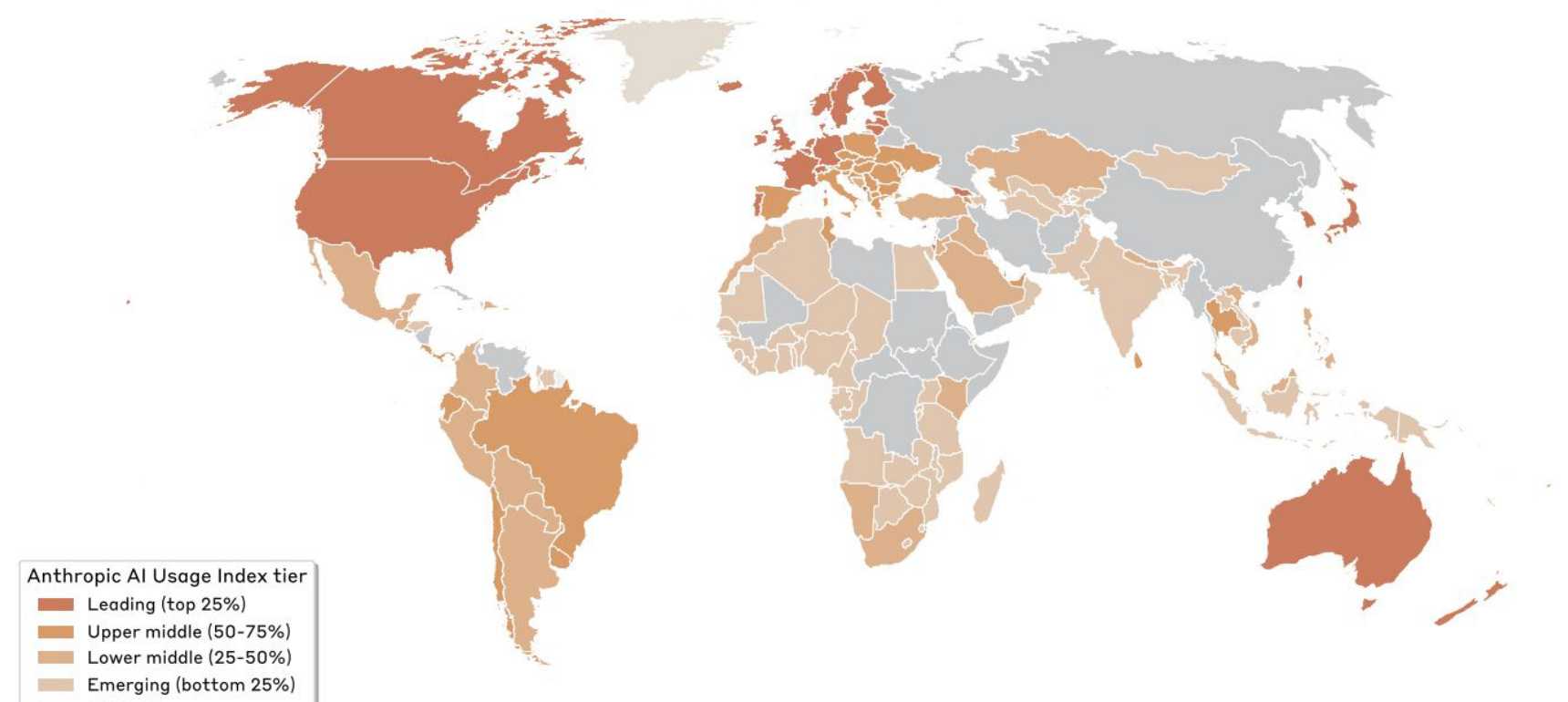
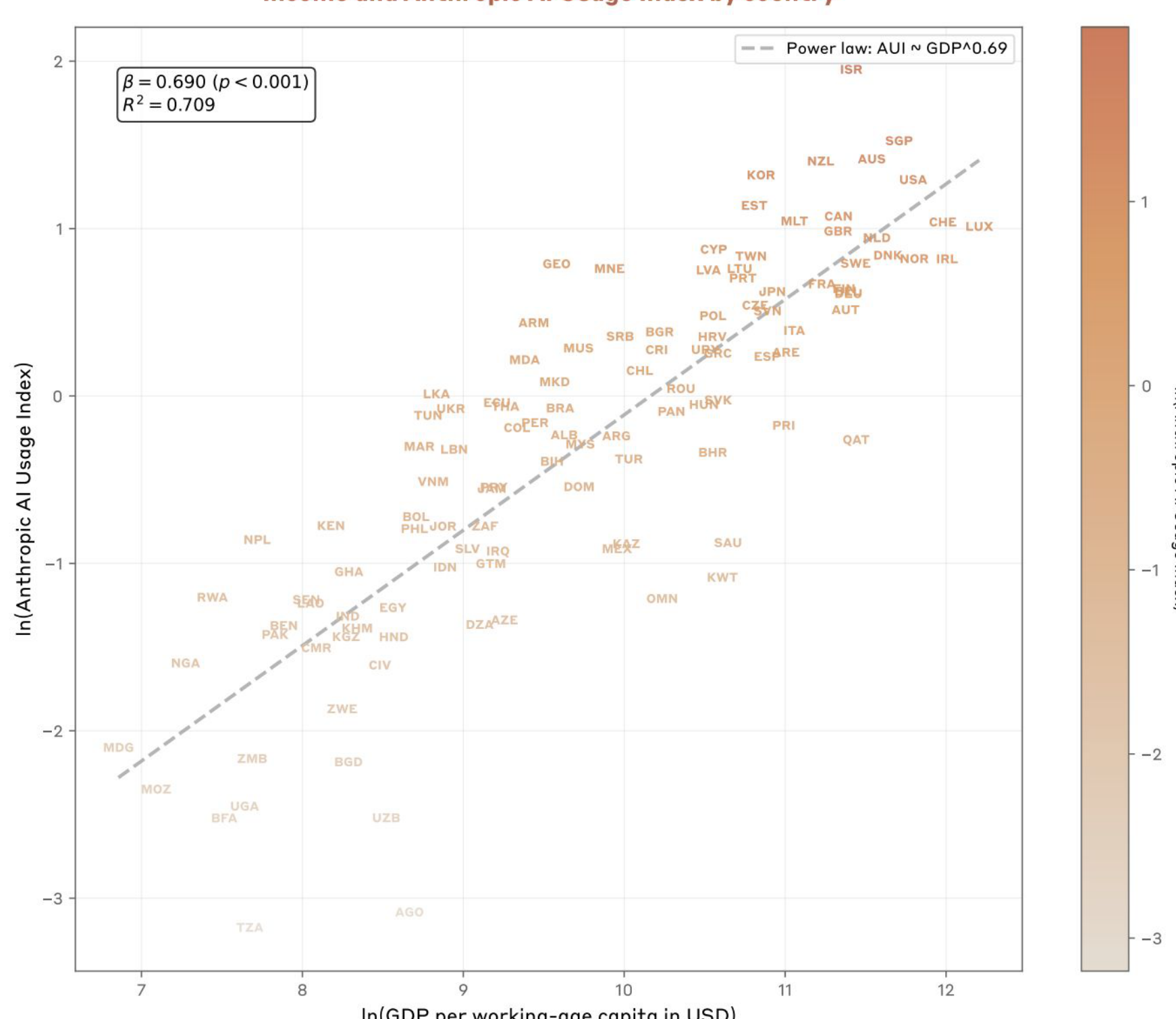
The same gap shows up in who uses these tools. Anthropic publishes an index of Claude use by country. Use rises closely with national income, and twenty-five countries show almost no use at all.22Anthropic, Anthropic Economic Index, 2025. Usage scales with GDP per working-age person at roughly a power of 0.69. They include Tonga, Samoa, Nauru, and Palau. These countries are parties to the same negotiations and are among the most exposed to climate change.
Stakeholder insights
Youth negotiators name what makes the work hard. Their answers set the bar for every tool in this book.
We interviewed youth climate negotiators from several countries. They described the same problems and wanted similar kinds of help.11Six negotiators from Liberia, Paraguay, Peru, Nigeria, Lebanon, and Indonesia. The full summary is in the appendix.
3.1Key challenges and pain points
Language. Most people in the room do not speak English as a first language.
Technical terms. UNFCCC jargon takes years to learn (Liberia, Paraguay).
Passing on knowledge. Some people have the technical knowledge and others do not. Much of it is lost when delegates change between sessions.
History. It is hard to find out what happened in past negotiations (Lebanon).
Talking to senior negotiators. These conversations are hard under pressure (Peru, Nigeria). Younger delegates have to earn respect before people listen to what they say.
Reading other parties. Positions change quickly and are hard to follow.
Time. There is never enough time to take in everything that matters.
Speaking clearly. Making a complex point quickly and accurately in English is a constant struggle.
3.2Wished-for tools and resources
Language tools. Better writing and grammar help, made for UNFCCC texts instead of business English.
Fast search. Tools that scan long documents, pull out the important parts, and confirm which version of a text is the latest.
Tailored training. Learning materials suited to a negotiator's region, negotiating group, and experience.
At the time of the interviews, negotiators used Grammarly for writing and Google Drive for working together. One negotiator used no translation tools at all, because the meaning of negotiation language gets lost in translation.
LLMs for negotiations
Where a language model helps across the negotiation cycle, and where it does not.
Climate negotiations cover many subjects at once: emissions, biodiversity, money, and politics. To keep up, a negotiator needs three things.
Fast access to information. Climate science keeps changing, and negotiators need the latest facts quickly.
Careful drafting. One word in an agreement can make it work or make it fail.
Many languages. Parties come from everywhere and speak many languages.
4.1Where models help
Communication. Drafting and translating texts, so that parties with different first languages understand each other correctly.
Research. Collecting and summarising large amounts of material, such as scientific studies, policy papers, and past agreements, so you stay up to date.
Exploring scenarios. Talking through what different policy choices might lead to, so you can test a position before you commit to it.11This is sometimes called predictive modelling, which overstates it. Language models do not run climate or economic models. They restate and compare scenarios, and any number they produce needs checking against a real source.
Summarising arguments. Laying out what each party has argued, so you can see the main points and the counterpoints.
4.2Potential pitfalls
The benefits are real. So are the risks, and some of them matter a lot in diplomacy.
Oversimplifying. Models shorten things. When they do, they can drop the one qualifier a party spent three sessions fighting for.
No sense of the room. A model cannot read the mood or the politics of a negotiation. It does not know what was agreed in the corridor.
No real expertise. A model can sound like a climate policy expert without being one. If you rely on it, you can end up with incomplete or wrong information.
Security and privacy. Negotiations often involve sensitive material. Anything you paste into an online AI service leaves your delegation. Few people read the terms that say how it is stored.
Ethics. Be open about when you use AI. Keep people responsible for decisions. Watch for misuse.
Misunderstanding. A model can misread what you asked for. It may give you text that sounds like your position but is not.
Using the models
Which model and on whose terms, how to write a prompt, and a library you can copy.
5.1Which model, and on whose terms
There are two kinds of AI assistant. Which kind you use matters more than the brand.
Closed weights. ChatGPT, Claude, and Gemini run on company computers. You reach them through an account. They are the strongest models and the easiest to start with. The free versions can draft, translate, and summarise. Paid versions cost about twenty dollars a month. They handle longer documents and file uploads, and include the agent features in chapter 6. Everything you type goes to the company. Depending on your settings, the company may keep it, have staff read it, or use it to train its next model.
Open weights. Llama, Mistral, Qwen, Gemma, and DeepSeek publish their models for anyone to download. That means you, your institution, or a provider you pick can run them. Ollama installs one on a laptop in a few minutes. Polly, run by GainForest and the Youth Negotiators Academy at polly.ai4cop.org, is an online open weights model that keeps no record of what you send. Chapter 11 explains how to run your own.
A simple rule to start. Use a closed model for material that is already public. Use an open weights model for anything that is not. Never paste a position your delegation has not yet tabled into a service you do not control. Chapter 10 explains what is at stake. Read it before you open an account.
Whichever you choose, install the phone app. Voice input helps when you are walking between sessions. Speaking a rough idea in your own language often gives a better draft than typing a careful sentence in English.
5.2Prompt engineering 101
The instruction you type is called a prompt. The clearer and more specific your prompt, the better the answer.
A prompt can have up to four parts. You do not always need all of them.
Instruction. What you want the model to do.
Context. Background that helps the model give a better answer.
Input. The text, question, or document you want it to work on.
Output format. What the answer should look like.
5.3What makes a prompt good
Six habits do most of the work. They apply to every model.
Be clear and detailed. Say who you are, what you want, and what the answer should look like. The model does not know where you are or what is going on around you.
Show an example. One sample of the answer you want works better than a paragraph describing it.
Ask for quotes. Tell the model to quote the passage it relies on. Tying an answer to a real document is the best protection against made-up facts.
Label the parts. Put each part in tags, like <context>, <task>, and <text>. Then the model can tell your instruction apart from the document you pasted.
Let it think first. Ask for the reasoning before the answer. Models make fewer mistakes on multi-step tasks when they work through the steps.
Give it a role. "You are a loss and damage researcher" usually gets a better answer than the same request with no role.
Then keep going. Improve the prompt and ask again. The second try is almost always better than the first.
Build one habit from the start. Ask for sources, and ask the model to mark the parts it is unsure about. If you cannot check an answer, you cannot use it in a plenary.
The anatomy of an intervention
Negotiators write interventions more than anything else. A good intervention prompt has five parts: who is speaking and where, the one issue, the evidence, the agreement it links to, and what should be done.
1As a youth delegate from Malaysia at COP29, draft a two-minute intervention 2addressing the loss and damage affecting children in Malaysia. Highlight 3concerns such as rising sea levels threatening coastal communities, educational disruptions from climate impacts, and mental health challenges for children. 4Offer specific recommendations for prioritising funding to protect children's rights and enhance their participation in climate discussions 5within the Paris Agreement framework.
Leave out any part and the draft gets worse. Without the role, it writes for nobody. Without the evidence, it writes feelings instead of facts. Without the last line, it links to no agreement anyone can act on.
5.4Prompting for different use cases
- Data analysis
Given this spreadsheet, plot the average emissions increase over the last years, state your method, and list the assumptions you made about missing data.
Setup: File upload - Translation
Translate this paragraph into Spanish, keeping the formal register used in decision text.
Setup: Any model - Summarising
Summarise the LDC Group's intervention at the Global Stocktake Technical Dialogue on 10 June 2023, and quote the passages you are drawing on.
Setup: Web search on - Preparing a speech
You are the speech writer for a UN climate change negotiator. You are writing about the UK's capacity building efforts. I am the negotiator. Which five questions would you ask me to get the information you need to draft a statement?
Setup: Any model - Preparing for counter-arguments
Loss and damage is a key issue in the climate negotiations. You are a loss and damage researcher. List the main reasons some countries give loss and damage low priority. Then write a strong counter-argument showing why a loss and damage fund is needed.
Setup: Any model - Drafting a statement or speech
You are a speechwriter drafting a statement using the questions above. Write a 300 word statement on the UK's climate capacity building efforts, in the style the UK Government uses.
Setup: Any model - Explaining jargon
Explain what "means of implementation" means in this paragraph, in plain language, and give one example of how the phrase has been used in a previous decision.
Setup: Any model - Finding the document
Which decision text carries the mandate for this work programme? Give me the document symbol and quote the paragraph it sits in.
Setup: Retrieval - Translating for a local audience
Translate this intervention into Bahasa Malaysia for a community audience, keeping the meaning and dropping the UNFCCC jargon.
Setup: Any model
Agents
A second way of working: a brief instead of a prompt, and ten use cases to try.
So far everything has worked the same way. You type a request, you read the answer, and you decide what to do with it. Four changes have added a second way of working.
Models can read more. A model can now take in a whole negotiating text, its earlier versions, and your briefing notes at once.
Models can search. A system can search a set of documents or the web before it answers, and quote what it found. That lets you check the answer.
Models can use tools. A model can be connected to a search engine, a spreadsheet, a calendar, or a folder of files. It can then act on them instead of only describing them.
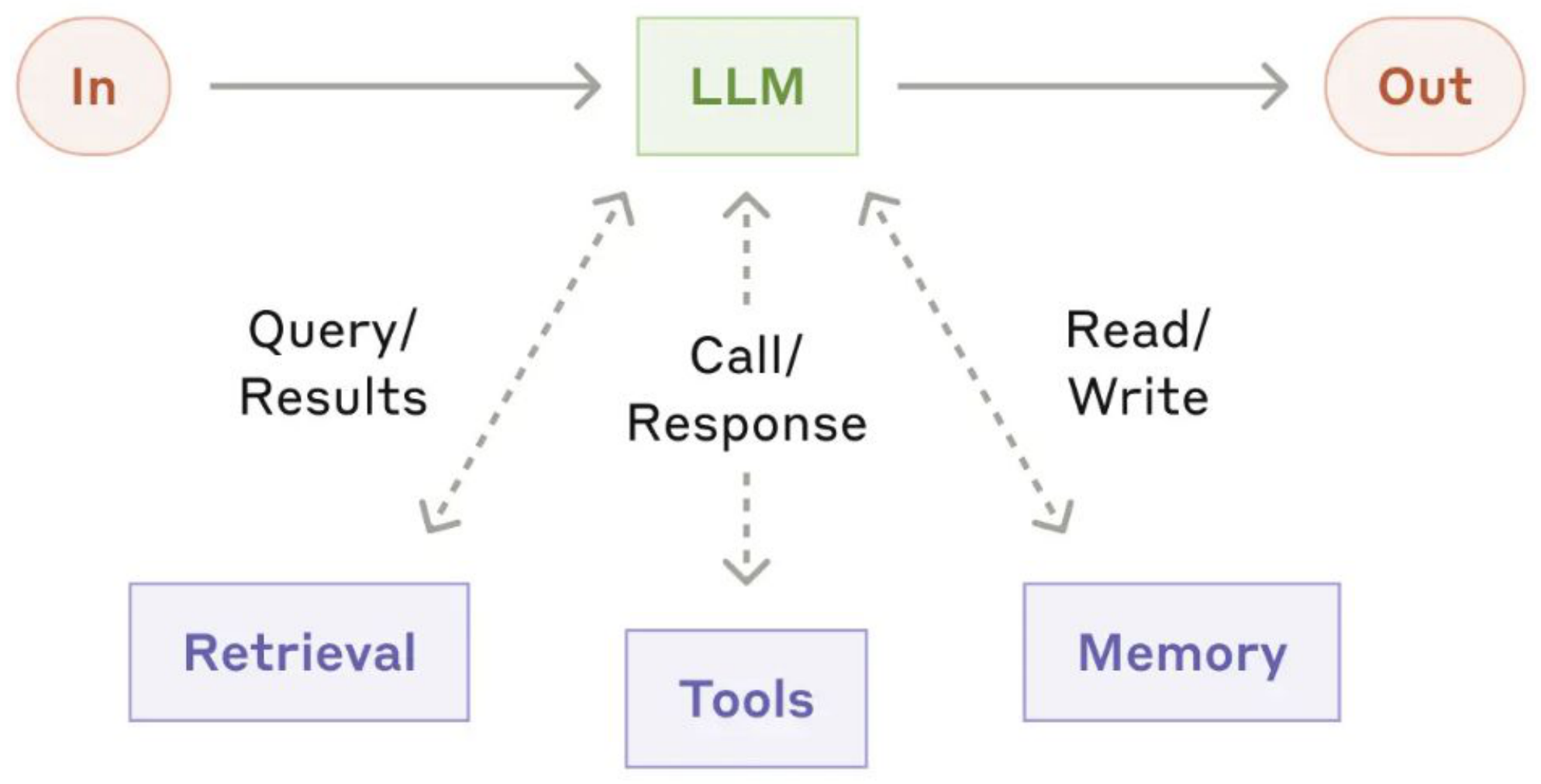
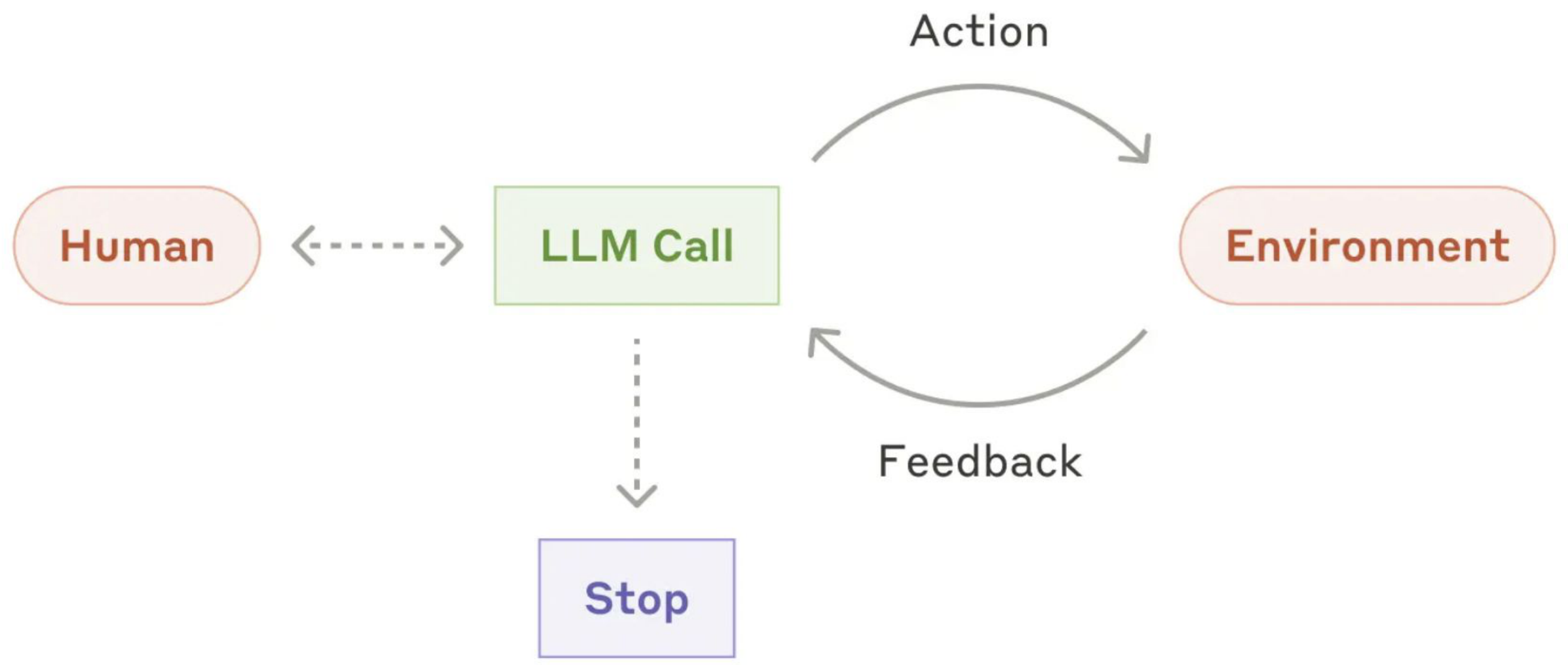
Models can repeat. A system no longer has to answer once and stop. It can plan, take a step, look at the result, and try again until the task is done.
Put these together and you get what people call an agent. An agent is a model with tools and memory that keeps working until a task is done. It works within permissions that a person gave it. It has no judgment and cannot be held accountable. It has a task and a set of permissions, nothing more.
6.1Three ways of working
Chat. You ask, it answers, you check. Good for drafting, translating, explaining, and practice.
Search. The system first searches a fixed set of documents, then answers and shows its sources. Use it for any fact about the negotiation: how a text changed, what parties said, past decisions.11If a system tells you what a paragraph of decision text says and cannot show you the paragraph, treat it as a rumour.
Agent. The system carries out a task in several steps using tools. Use it for repetitive work where you can check the result, such as tracking changes between drafts or putting together a daily brief.
6.2Use cases
- Tracking text changes
Compare revision 3 of this draft decision with revision 2. List every substantive change, quote both versions, and flag the changes that affect my delegation's red lines.
Setup: Files attached - Mapping positions
From these submissions, build a table of party positions on Article 6.4 with a quote and a reference for each row. Mark any position you inferred.
Setup: Retrieval - Tracing history
Trace how the phrase "common but differentiated responsibilities" has been qualified in decision text since 2015, quoting each decision.
Setup: Retrieval - Overnight reading
Here are the four texts published today. Tell me what moved, what stalled, and which three pages I must read before tomorrow.
Setup: Files attached - Daily digest
Every evening, collect the day's published texts from the tracks I follow, summarise what changed, and send me the list.
Setup: Scheduled agent - Reading brackets
For each bracketed option in this paragraph, explain who benefits, who resists, and what a fallback formulation could look like.
Setup: Files attached - Rehearsal
Play a negotiator who opposes this text. Push back on my intervention, and do not be agreeable.
Setup: Chat - Back-translation
Translate my formulation into French, then translate it back into English independently, and tell me what drifted.
Setup: Chat - Handover
From my notes across this session, write the handover document for whoever takes this file next cycle.
Setup: Files attached - Data work
From this emissions spreadsheet, plot the trend for these countries since 2010, state your method, and list every assumption about missing data.
Setup: File access
6.3Working with an agent safely
When a chatbot misunderstands you, you get a bad paragraph. When an agent misunderstands you, it may act on the mistake.
Check anything you will repeat. Open one cited document and confirm the quote is really there before you use it in the room.
Give the fewest permissions possible. A system that reads your files does not also need to send email.
Do not trust outside documents. A file someone else submitted can contain hidden instructions aimed at the agent.
Decide who signs off. Agree who approves any text written with AI help. When several tools are involved, nobody else will do it.
Agents for emails
Inbox triage, drafting, and follow-through, delegated with care.
Email is still the main way professionals communicate. Three things make it hard.
Volume. Inboxes overflow, and sorting them takes time you do not have.
Writing well. A clear, short email that gets action takes skill.
Languages. You often have to write in a language that is not your own.
An assistant connected to your mailbox can read the whole thread by itself. Give it permission to read and to draft. Keep sending for yourself.
- Meeting follow-up
Summarise the key points and commitments from the recent negotiation meeting, say who made each one, and draft a polite follow-up email to the attendees about the agreed actions.
- Scheduling
Write a polite, flexible email proposing several dates and times for the next round of meetings, shown in every participant's time zone.
- Daily briefing
Write a short daily briefing email on progress in the latest sessions: new proposals, points agreed, and points still in dispute.
- Setting priorities
Write an email to the negotiation team proposing how to rank agenda items by urgency, impact on climate goals, and chance of agreement.
- Sorting the inbox
Group my unread messages into: needs a decision from me, needs a reply, needs forwarding, needs nothing. Draft replies for the third group only and leave them unsent.
- Checking the tone
Rewrite this email in formal diplomatic language without changing any substantive commitment, then list what you changed so I can check.
These systems tend to write in a warm, agreeable voice. That voice can give away things your original text did not. Ask the model what it changed, and read the list.
Agents for logistics
Schedules, checklists, and travel. The low-risk work agents do well.
During a session, schedules, checklists, and travel bookings pile up fast. Three problems come up again and again.
Time. Deciding what to do first, and how long to spend on it, is hard.
Forgotten tasks. Important items slip off the list.
Travel. Finding flights and hotels that fit your schedule and budget takes hours.
This is the lowest-risk work in the guide and the best place to start using an agent. The tasks repeat, you can check the results easily, and very little of it is confidential.
- Bookings
Find the cheapest and most convenient flights and hotels for a trip from [departure city] to [destination city] on [dates]. I prefer morning flights and a hotel close to the venue. Show me the trade-offs instead of one recommendation.
- Checklists
Make a full checklist for a two-week international session: documents, accreditation, clothes for changing weather, work equipment, and offline copies of key texts.
- Planning the day
Look at my calendar and the session timetable, then propose a schedule with meetings, time for my own work, exercise, and personal time, given these deadlines and commitments.
- Tracking progress
Make a template for tracking the workstreams I follow, with milestones, deadlines, and space for updates and next steps.
Logistics is also where you will first give an agent real access to your calendar, email, and files. That is fine. But it is also where the habit starts of giving a little more access each time. The system that books your flights does not need to draft your positions.
Agents for other activities
Wellbeing, culture, and the human side of a session, with honest limits.
Climate negotiations involve people as well as facts. Emotions, cultural differences, and mental health all play a part.
Mental health. Climate change and the pressure of negotiating wear delegates down.
Cultural misunderstandings. People from different cultures can misread each other. That causes friction and slows talks down.
In this one part of the guide, a simple chat window is better than an agent. These are conversations. They do not need a system with access to your files.
- Cultural brief
I am in a UN climate change negotiation with someone from Kenya. What should I be culturally aware of to advance my negotiation?
- A lift
I am feeling down right now, can you tell me something uplifting?
- Debrief
Here is what happened in that session and how I handled it. What would a more experienced negotiator have done differently?
Two warnings. First, a cultural brief describes a country in general, but you will be talking to one person. Use it as background, not as a prediction. Second, a model is a fine place to put down a thought at one in the morning. But it is not a doctor or a colleague, and it is not confidential. If you feel more than tired, talk to your head of delegation, your programme's support contacts, or a professional.
Sovereignty, and who owns what
Who owns the words, the data, and the decisions when a model sits in the room. One page.
These tools can level the field in multilateral talks. They lower the language barrier that decides who speaks with confidence. They shorten documents nobody has time to read. They give a two-person delegation some of the reach of a fifty-person one. That is valuable. But before you type, ask a few questions.
Who owns the data? Text you paste into an online assistant leaves your delegation. Depending on the account and its settings, the company may keep it, have staff read it, or use it to train its next model. National positions, instructions from your capital, and anything told to you in confidence do not belong there.
Who owns the decision? A model writes text that reads like a position. If it drafts and nobody checks, the thinking behind your country's position starts to happen outside your delegation. Every text that leaves must belong to someone with a mandate.
What can you not see? OpenAI and Anthropic do not show you the model's full reasoning. You get an answer, and sometimes a summary of how it got there. The actual steps stay with the company. You cannot check them, repeat them, or show a colleague why the system said what it said.
Open or closed weights? A model's weights are the numbers it learned in training. ChatGPT, Claude, and Gemini keep theirs on company computers. They are the strongest models and the easiest to use. Llama, Mistral, Qwen, Gemma, and DeepSeek publish theirs, so you can run the model on your own computer or on a server in your region. Open models translate, summarise, and draft well. They are weaker on the hardest multi-step problems. And if you hold the weights, nobody can raise the price or switch the model off in the middle of a session.
Sovereignty-aligned AI means the delegation, region, or community sets the terms. They choose which model to use, what data goes into it, and who may check what it did. They can also say no. In the COP process, the parties with the least capacity usually have the most at stake. So this is a practical question.
A working rule. Use the strongest online model for public material, background reading, drafting, and practice. For anything about a position that is not yet public, use an open weights model, or a service under a contract your institution has read.
This guide exists to keep that trade-off in view. The earlier chapters show what these systems do well. This one shows what you give up in return.
Deploying your own sovereign AI
Running an open weights model yourself: what to run, what the hardware costs, and how to set it up.
The last chapter set out the trade-off. The strongest answer to it is to run the model yourself.
When you host your own model, nothing leaves the building. You do not have to trust a company's data policy. No terms of service can change under you. No account can be suspended in the middle of a session. And your institution builds the skill itself instead of renting it.
Until recently, running your own meant settling for a much weaker model. That is no longer true.

Artificial Analysis publishes an Intelligence Index that scores models on a common set of tests. Kimi K3 and GLM-5.3 both score 60, three points behind Claude Opus 5 at 63. Qwen3.8 follows at 58. Nineteen of the 29 models on the index have open weights, although most of the top places still go to closed models.11The chart counts GLM-5.3 and GLM-5.3-Flash as proprietary. Z.ai publishes both sets of weights under an MIT licence, so this book counts them as open, which is why the figure shows seventeen blue bars and the text says nineteen. A year ago the best open model was thirteen points behind the best closed one. The gap has closed fast and may close further.
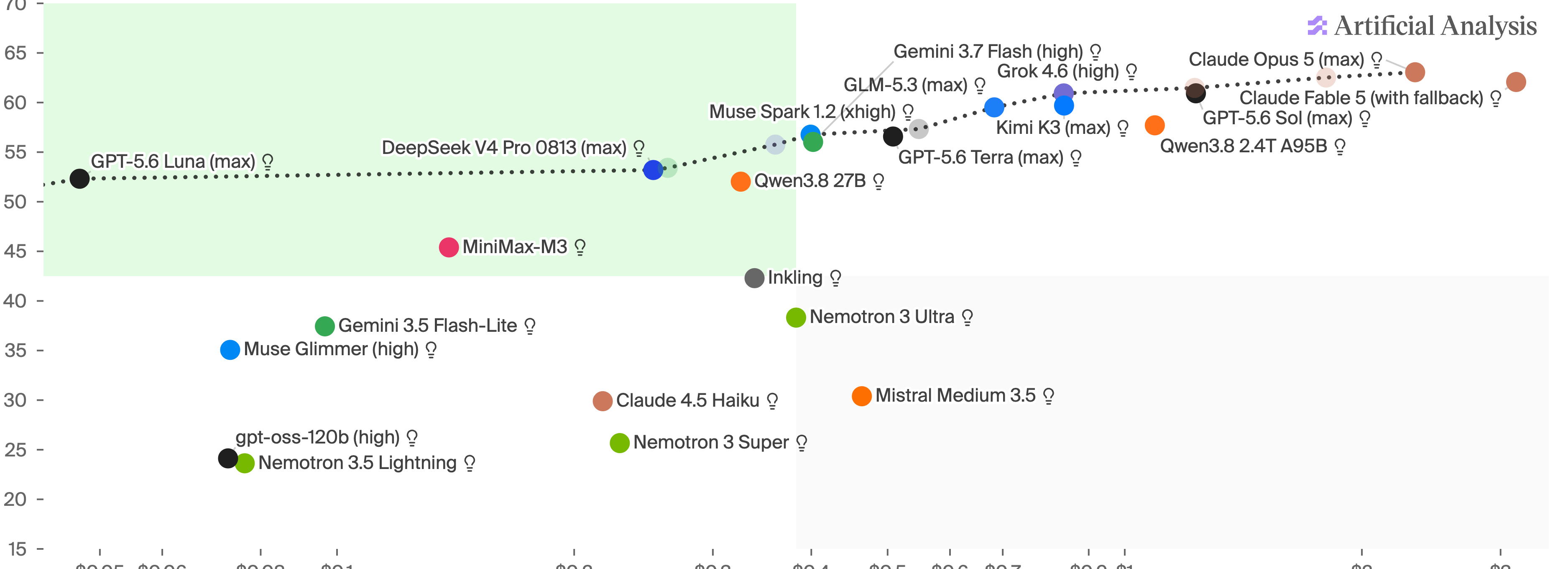
Price is the other half of the case. GLM-5.3-Flash scores 57 at about nine cents per task. DeepSeek V4 Pro 0813 scores 53 at about a quarter of a dollar. Both sit in the high-score, low-cost corner. Claude Opus 5 scores 63 but costs about ten times as much as DeepSeek. That difference is why a delegation can afford to run its own.
11.1What to run
| Model | Lab | Weights | Index |
|---|---|---|---|
| Kimi K3 (max) | Moonshot | Open, use restricted | 60 |
| GLM-5.3 (max) | Z.ai | Open, MIT | 60 |
| Qwen3.8 2.4T A95B | Alibaba | Open, use restricted | 58 |
| GLM-5.3-Flash | Z.ai | Open, MIT | 57 |
| DeepSeek V4 Pro 0813 | DeepSeek | Open | 53 |
| Qwen3.8 27B | Alibaba | Open | 52 |
| MiniMax-M3 | MiniMax | Open, use restricted | 45 |
| Nemotron 3 Super | NVIDIA | Open | 26 |
| gpt-oss-120b (high) | OpenAI | Open | 24 |
As of 26 August 2026. Read the licence before you choose. Several of the strongest open models limit commercial use. For a delegation that is usually fine. For a company building a product on top of one, it is not.
11.2What it costs
An NVIDIA DGX Spark is a desktop computer with 128GB of memory. It costs 4,699 dollars today. You can plug two of them straight into each other to get 256GB for about 9,400 dollars. That pair can run a large model like DeepSeek at 55 to 60 tokens per second, which is faster than you can read. It can also hold about a million tokens of text at once, roughly several thousand pages. That is enough for a working delegation.
One unit can run a smaller model (27 to 35 billion parameters) fast enough for sixty people at once. That covers translation, summaries, and drafting for a whole office. Three or four units, with 384 to 512GB, can run the largest open models in full.
Compare that with paying a subscription for every delegate. The hardware pays for itself within one or two negotiating cycles, and it keeps working after the funding ends.
11.3How to set it up
Run the model with software called vLLM or SGLang. Both work the same way as OpenAI's service. So any tool that works with ChatGPT will work with your own server once you change the address and the key. For a first test on a laptop, Ollama or llama.cpp are easier. NVIDIA publishes setup guides for the Spark, and public community guides explain how to connect two, three, or four units.
If you cannot run your own before the next session, use an online service that has signed a zero data retention agreement. That means a written promise not to store what you send. Treat it as a temporary fix.
11.4One caveat worth knowing
The index above averages nine different tests, and open models do not fall behind evenly on all of them. The gap is biggest on the hardest reasoning tasks and on hallucination. On both, closed models are still clearly ahead. For a negotiator, hallucination is what matters most. So point the model at your own documents, ask for sources, and open them.
Civic AI
Using a model to listen to a whole constituency. The tools that already do it, and their limits.
The last chapter ended with a model running on your own hardware. This one is about using it to listen to your own people.
So far this guide has treated AI as a tool one person uses for their own work. There is a second use. It changes what a small delegation or a youth constituency can do. A model can help you listen to far more people than a human team could. Then you can bring what they said into the room, with the evidence attached.
This is called broad listening. A poll squeezes people into answers someone else wrote. Broad listening works the other way round. People answer in their own words. Software finds the patterns in the answers. Then the patterns go back to the people who wrote them, so they can correct them.
12.1Polis, the oldest of these tools
Polis is a survey that works like a conversation. People write short statements. Everyone else votes agree, disagree, or pass on statements picked partly at random. The system groups voters by how they voted. It then highlights the statements that people across all the groups agree on, instead of the ones that win a simple majority.
Taiwan is the best-known example. After the Sunflower protests of 2014, the g0v civic tech community and the government ran a process called vTaiwan on Polis. More than 200,000 people took part across its consultations. One consultation on ride-hailing apps like Uber found statements that drivers, taxi companies, and passengers all agreed with. The regulation was then written from those statements.
Polis is free and open source (AGPL licence). The Computational Democracy Project maintains it. It is older than today's language models and does not use one at all. That is part of why it still works well.
12.2Talk to the City, and what the models added
Talk to the City adds a language model to do the reading. The AI Objectives Institute built it. It takes interviews, survey answers, forum posts, or transcripts. It breaks them into single claims, sorts the claims into topics, and writes a report. Every line in the report links back to the quote it came from. Newer versions also run the interview themselves. They ask follow-up questions like a person would, instead of reading from a fixed list.11One project used an AI moderator to interview 81,000 people worldwide, with the model following up on whatever a participant raised. That scale is real, and so is the caveat below: the model decides what to ask and what to keep.
Those links back to the source are what matter. A summary nobody can check is just a claim. Talk to the City is open source (Apache licence), and you can run it yourself.
12.3Team Mirai, the version with seats in parliament
Takahiro Anno is a software engineer and science-fiction writer. In 2024 he ran for Governor of Tokyo with no party and won 154,000 votes. During a seventeen-day livestream, an AI avatar trained on his manifesto answered 8,600 questions from voters. In May 2025 he founded a party, Team Mirai. It won a seat in the upper house that July, and eleven seats in the lower house in February 2026, with about seven percent of the vote.
The system behind it is the part worth copying. A citizen talks to an AI Interviewer. It asks follow-up questions and turns the conversation into a draft policy proposal. The party only receives the draft if the citizen confirms it says what they meant. When enough people support an idea, it becomes a proposal the party's legislators can submit. In one consultation the interviewer collected more than 1,200 hours of conversation in a few days. A human interviewer would need about fifty days without sleep to do the same.
Two design choices matter most. First, the citizen gives the final approval, so the model cannot quietly change what they meant. Second, the party takes no position on deeply divisive questions. It puts those to a direct vote, because no software can make a real conflict of interest go away.

Their broad listening software, kouchou-ai, is open source. It started as a version of Talk to the City adapted for Japanese city governments. For a delegation, it is better to adapt an existing public tool to local needs, openly, than to pay someone to build a new one.
12.4Three more worth knowing
Agora Citizen Network. A fully open source version of Polis-style grouping, built for the open web. It is moving onto the AT Protocol, an open standard for social data. That way a discussion is not locked inside one company's database. In September 2025, during the bloquons tout strike, a French team ran a national consultation on it. They wanted to see if an angry country could still find statements people shared.
Habermolt. A research experiment that goes the other way. It does not try to hear more people. Instead it gives each person an AI agent that learns their views and debates for them in meetings they never attend. You read what your agent said and correct it. It is based on DeepMind's Habermas Machine. It is an open question, not a finished tool. An agent that speaks for you is exactly what chapter 10 warns you to be careful about.
Simocracy. GainForest, who co-publish this guide, built it. So read this as an example, not a recommendation. Each participant writes a "sim". A sim has an avatar, a constitution that says what it stands for and what its red lines are, and a way of speaking. The sim is stored on the AT Protocol, belongs to the person who wrote it, and attends meetings for them. Groups discuss proposals in public, on the record, and decide how to split a shared budget. It has been used with Funding the Commons at Frontier Tower in San Francisco and in the Agent Village experiment. In both cases, people made the final funding decision.
12.5What this is for at a COP
A constituency position. YOUNGO, the youth constituency, has hundreds of members in every time zone and a few days to agree on one line. Broad listening replaces a call nobody can join with text everyone can check.
A call for inputs. A submission window closes with 180 documents, and no delegation has read them. Group the claims, keep the quotes, and open the ones that matter.
A two-person delegation. Often there is a gap between your mandate and what people at home actually want. Broad listening narrows that gap, cheaply, between sessions.
Reporting back. After a session, run the same process in reverse. Explain what was decided and what it means locally, and hear what people say about it.
12.6What to check before you run one
Who wrote the questions? A model that runs interviews decides what to ask, what to keep, and how to report it. That gives it real power over the result. Publish the prompt and the list of topics, just as you would publish a questionnaire.
Participants check their own words. Nothing goes into the record until the person who said it confirms the summary. This rule is what stops a machine from putting words in people's mouths.
Language. These tools work in the languages people actually speak. That is their big advantage over a consultation run only in English. Check the results in each language. Do not translate everything into English first.
Do not fake people you could ask. AI-generated participants are cheap, and worthless as evidence. If a group is affected, spend the money to reach them.
Host sensitive material yourself. Polis, Talk to the City, kouchou-ai, Agora, and Simocracy are all open source. Chapter 11 explains how to run them on your own hardware.
The environmental footprint
Your own use is small. The industry total is the serious number. Here is the arithmetic for both.
AI uses energy and water. A climate negotiator who uses it should be able to say how much. Your own use is small. Total demand is large, and growing. You need to say both. Saying only one of them is how this topic usually goes wrong.
13.1Your own use is small
Google measured a typical text prompt to Gemini at 0.24 Wh of energy, 0.03 grams of CO2e, and 0.26 millilitres of water.11Google, Measuring the environmental impact of delivering AI at Google scale, arXiv:2508.15734, August 2025. The figure includes idle capacity and data-centre overhead, which most published estimates leave out. That is about the same as running a laptop for a few seconds. Even a full day of heavy use adds up to less than a short car trip.
Polly shows this figure for every account, and publishes how it works it out.22The method and every constant are in footprint.ts in pi-village-core. A number a negotiator cannot interrogate is worse than no number at all. The calculation starts from how much of the model is active for each word it handles:
Reading your prompt costs about a quarter as much as writing the answer. Re-reading a prompt the system has already seen costs a tenth. So the three are counted separately. Polly runs a model that uses 18 billion of its parameters for each token. On that model, a typical exchange uses about 0.10 Wh and 0.11 millilitres of water. That is below Google's figure.33The joules-per-token constant is calibrated against the ML.ENERGY benchmark, which meters GPUs directly across 1,858 serving configurations, rather than assumed. Doing that halved the estimate: the guess it replaced was pessimistic about how well a busy server batches work.
Take all these numbers as correct to within a factor of two. They leave out the energy used to train the model, the water used to make the electricity, your own device, and the carbon from building the hardware.
13.2Total demand is large
One prompt is small. Billions of prompts are not, and more people send them every month. Data centres are adding electricity demand faster than grids are switching to clean power. New data centres are going up in places already short of water. And the companies that publish the small per-prompt figures have seen their total emissions rise since they started building these systems.
The per-prompt figure also leaves out training, which is large. Before a top model answers a single question, training it uses gigawatt-hours of electricity. That cost is spread over every prompt the model ever answers. So it disappears in a per-prompt figure, but it is large at a national level.
Your own use is small. The total it is part of is a large and growing demand on energy, water, and land. Reporting the first without the second is the kind of accounting a negotiator would never accept from another party.
13.3What to do about it
- on the frontier
- beaten by a model on the frontier
- closed model, placed from its price
- one model at different efforts
Up and to the left is better. A filled dot is on the frontier: no other measured model is both smarter and lighter to run. An ✳ is a closed model placed from its price, a rough estimate that cannot set the frontier. Hover or tap any dot for its figures.
Scores: Artificial Analysis Intelligence Index, 27 August 2026. Energy: The ML.ENERGY Benchmark v3.0.
Turn reasoning off when you do not need it. This makes the biggest difference, and it is just a setting. The same model with reasoning on can use twenty to forty times as many tokens, and energy use rises with tokens. Translation, summaries, and reformatting almost never need reasoning.
Next, choose a smaller model. Some models only use a few billion of their parameters for each token. They cost a fraction of what a model that uses all its parameters costs. What you pay for, in energy, is the active part of the model, not its headline size.
Do not treat price as a guide to footprint. Among open models that publish enough data to check, price and energy use do move together. But the price per unit of computing varies sixty times over. Two models can cost the same to use while one uses several times more energy.
Ask providers for their figures, including water. Ask which power grid serves your requests. These are fair questions to ask a supplier, and few people ask them.
Report your own figure when you use these tools in your work. A delegation that publishes the footprint of its own AI use can fairly ask others to do the same.
Conclusion and recommendations
Strengths, weaknesses, and recommendations for negotiators and their programmes.
14.1Strengths and weaknesses
Strengths. Models are fast at reading and summarising the large amounts of text that climate policy depends on. They can write reports, draft policy, and play out mock negotiations in plain language, which saves time and money. They can help many people at once: policymakers, researchers, and activists.
Weaknesses. Models can be biased, and that bias shapes their answers unless someone checks and corrects it. They are only as good as the data they learned from, which limits how well they handle subtle climate issues. Without a person checking, they often misread complex legal and technical language.
Opportunities. Tailored messages that reach different groups working on climate. Links to other tools that analyse environmental data, which support better policy. Explaining climate policy to people who are not experts.
Threats. Misinformation, when a model produces wrong or misleading content from bad sources. Over-reliance, which stops people building local expertise in climate policy. A lack of openness and accountability when machines help make decisions.
Agents add two more threats. First, rich delegations will run well-managed systems, while smaller ones use free tools with unclear terms. Everyone seems to have equal access, but the gap gets wider. Second, when several people and tools work on a text, it becomes hard to say who is responsible for it. Decide that in advance.
14.2Recommendations
Three things are worth building: tools that translate UNFCCC technical language, platforms that analyse past negotiations, and support that gives young negotiators the technology they need to take part. Six more are worth adding.
Digital skills. Training on how to find your way around international policy databases and websites.
Live support. Tools that explain things during a negotiation, when you need it, instead of afterwards.
Negotiation practice. Mock negotiations for practising different situations.
Funding. Crowdfunding or small-grant platforms to help negotiators pay to attend. Negotiators from Liberia and Paraguay raised this.
Cross-cultural training. Programmes on the misunderstandings that negotiators from Peru and Nigeria described.
Mentoring. Networks that connect young negotiators with experienced ones, so knowledge is passed on between cycles.
For a negotiator, four habits cover most of it. Use these systems to prepare, to help with language, and to remember. Check anything you will say out loud. Never let a system speak for your party. Keep doing enough of the research yourself that you could still do it without help.
For a delegation, write down which tools people may use, what they may paste into them, and who approves a text written with AI help. One page is enough, and it costs less than a leak.
Questions and comments are welcome at team@gainforest.net.
References
Numbered the way the sidenotes cite them.
- Rosenblatt's perceptron and the 1958 demonstration, Cornell Chronicle
- Krizhevsky, Sutskever, Hinton, ImageNet Classification with Deep Convolutional Neural Networks, NeurIPS 2012
- Vaswani et al., Attention Is All You Need, Google Research 2017
- Radford et al., Language Models are Unsupervised Multitask Learners, OpenAI 2019
- Kaplan et al., Scaling Laws for Neural Language Models, OpenAI 2020
- Hoffmann et al., Training Compute-Optimal Large Language Models, NeurIPS 2022
- OpenAI, Introducing ChatGPT, 30 November 2022
- OpenAI, Learning to Reason with LLMs, 12 September 2024
- DeepSeek, DeepSeek-R1, 20 January 2025
- METR, Measuring AI Ability to Complete Long Tasks, 2025
- Anthropic, Anthropic Economic Index, 2025, usage by country and income tier
- Global Biodiversity Information Facility, occurrence data and its geographic sampling bias, gbif.org and the GBIF data blog
- Artificial Analysis, Intelligence Index by Open Weights and Proprietary, 26 August 2026
- Artificial Analysis, Intelligence Index vs. Cost per Intelligence Index Task, 26 August 2026
- NVIDIA, DGX Spark user guide and hardware overview
- The Computational Democracy Project, Polis, compdemocracy.org/polis and the source
- The Computational Democracy Project, vTaiwan, case study, 2014 onwards
- AI Objectives Institute, Talk to the City, talktothe.city and ai.objectives.institute
- Team Mirai, kouchou-ai (広聴AI), broad listening for Japanese municipalities, GitHub
- Team Mirai, AI interviews and the digital democracy manifesto, policy.team-mir.ai; Bruce Schneier and Nathan Sanders, Japan's Team Mirai Uses Tech to Bolster Democracy, Not Undermine It, Tech Policy Press, March 2026
- Agora Citizen Network, agoracitizen.network and From ZK-first to AT Protocol, our path to DDS, blog
- Low, Duys, Formanek, Hammond, Bakker, Habermolt: Delegating Deliberation to AI Representatives, arXiv:2605.24413
- Tessler et al., AI can help humans find common ground in democratic deliberation (the Habermas Machine), Science, 2024
- GainForest, Simocracy, a public ledger of citizen-built AI agents on the AT Protocol, simocracy.org
- Foresight Institute and the Cooperative AI Foundation, Supercooperation: The Future of AI for Democracy, workshop notes, ICML satellite workshop, Seoul, July 2026
- Anthropic, What 81,000 people told us about AI, AI-moderated interviews at scale
- Google, Measuring the environmental impact of delivering AI at Google scale, arXiv:2508.15734, August 2025
- Epoch AI, How much energy does ChatGPT use?, 2025
- GainForest,
footprint.tsin pi-village-core, the calculation behind Polly's per-account figures - GainForest, Generative AI + Climate Guide 2024, prepared for the Climate Youth Negotiator Programme ahead of COP29
Who made this
This guidebook comes from GainForest and the Youth Negotiators Academy, written for the Climate Youth Negotiator Programme.
Nothing you type into this site leaves your browser, and the search runs locally.
We update it as the tools change. If something is wrong, out of date, or missing, tell us. If you want to run your own sovereign AI, train your delegation, or work with us on the next edition, get in touch: team@gainforest.net.


Supported by Robert Bosch Foundation and Protocol Labs.
team@gainforest.net