Host your own AI
on hardware you control
Run the model yourself and nothing leaves the building. No data policy to trust, no terms that can change, no account shut off mid-session. Until recently this meant a much weaker model. Not any more.
01Why run it yourself
- Your data stays with you. National positions, instructions from your capital, and anything said in confidence never reach an outside company.
- Nobody can raise the price or switch the model off in the middle of a session.
- You can see every step. Online services hide the model's reasoning. On your own server you can log it and show a colleague.
- Your institution builds the skill instead of renting it every year.
02What it costs
Compared with a subscription for every delegate, the hardware pays for itself within a cycle or two, and keeps working after the funding ends.
03What to run
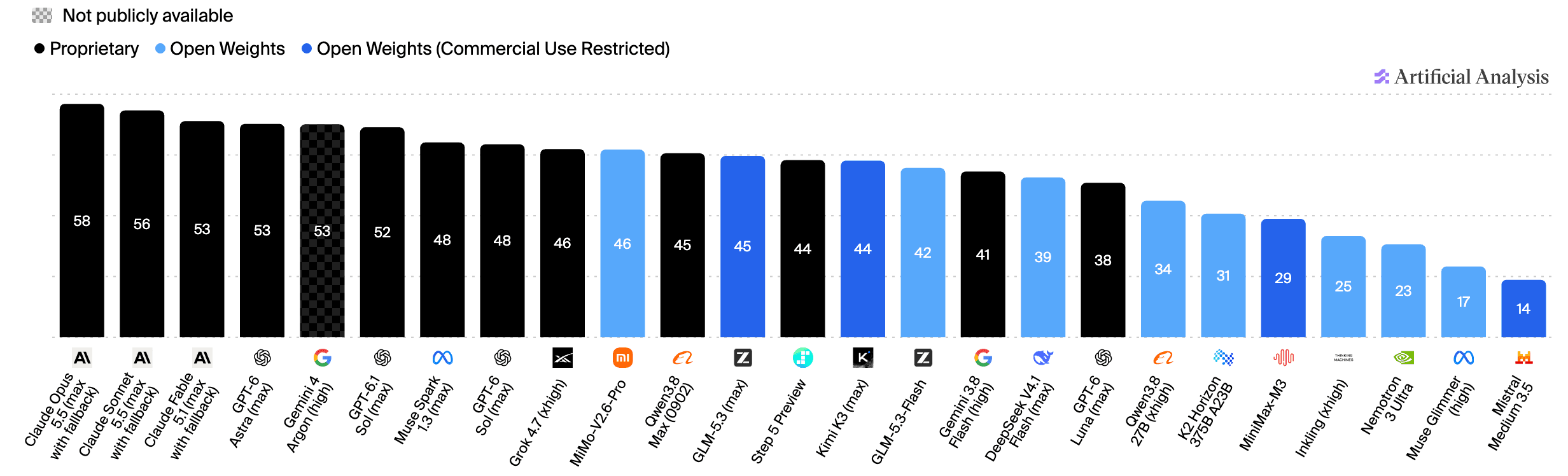
| Model | Licence | Index |
|---|---|---|
| MiMo-V2.6-Pro | Open | 46 |
| GLM-5.3 | Open, restricted | 45 |
| Kimi K3 | Open, restricted | 44 |
| GLM-5.3-Flash | Open, MIT | 42 |
| Qwen3.8 2.4T | Open, restricted | 40 |
| DeepSeek V4.1 Flash | Open, MIT | 39 |
| Qwen3.8 27B | Open | 34 |
Read the licence before you choose. Several of the strongest open models limit commercial use. That is usually fine for a delegation, but not for a company building a product on one.
Run it with vLLM or SGLang. Both work like OpenAI's service, so any tool that works with ChatGPT works with your server once you change the address and key. On a laptop, ollama run qwen3.8:27b
04Rented or sovereign
- Size or local control. A shared system is cheap and strong. It also decides the categories, makes you depend on it, and can make leaving impossible.
- Power and risk. Whoever holds the power should carry some of the risk. When you rent, the provider writes the terms and you live with the result.
- Open does not mean trusted. Closed systems can be checked under contract. You need a lasting right to check, and holding the weights is the cheapest way to get it.
- Skills build on each other. New open models come out every few months. A team that runs its own tries each one within a week and keeps the know-how. A team on a contract waits.
- The right to stay out. Some knowledge belongs in no model. Sovereignty includes refusing to become data.
From the AI4PG workshop on Decision Sovereignty in Nature, ETH Zurich, July 2026.
05Before you trust it
The index averages ten tests, and open models do not fall behind evenly. The gap is biggest on the hardest reasoning tasks and on hallucination, where closed models are still ahead.
For a negotiator, hallucination matters most. Point the model at your own documents, ask for sources, and open them.
06If you cannot yet
Use an online service that promises in writing to store nothing you send. Treat it as a temporary fix. Online models for public material and practice. Your own hardware for any position not yet public.